English
 Español
  Português
  русский
  Français
  日本語
日本語  Deutsch
  tiếng Việt
  Italiano
  Nederlands
  ภาษาไทย
  Polski
  한국어
한국어  Svenska
  magyar
  Malay
Malay  বাংলা ভাষার
  Dansk
Dansk  Suomi
Suomi  हिन्दी
  Pilipino
  Türkçe
  Gaeilge
  العربية
  Indonesia
  Norsk
Norsk  تمل
تمل  český
český  ελληνικά
  український
  Javanese
  فارسی
فارسی  தமிழ்
தமிழ்  తెలుగు
  नेपाली
  Burmese
  български
  ລາວ
ລາວ  Latine
  Қазақша
  Euskal
  Azərbaycan
  Slovenský jazyk
  Македонски
  Lietuvos
  Eesti Keel
  Română
  Slovenski
  मराठी
मराठी  Srpski језик

Call Us
+86-15768259626
Email Us
coco@zyepower.com

How long do solid state batteries last?
How Long Do Solid State Batteries Last?
A Realistic Answer for UAV Operators
Cycle count is the number most battery manufacturers lead with. 700 cycles. 800 cycles. Sometimes more. For UAV operators trying to plan replacement budgets and fleet management schedules, that number is useful but incomplete. What actually matters is how those cycles translate into calendar time — and whether the battery will survive that long even if you don't use it that hard.
Here's a more complete picture of solid state battery lifespan for commercial UAV operations.
Cycle Life vs. Calendar Life: Two Different Clocks
Every battery runs on 2 clocks simultaneously. The first is cycle count — how many times it's been fully charged and discharged. The second is calendar age — how long it's existed, regardless of how much it's been used.
Both matter. A solid state UAV battery rated for 800 cycles still experiences calendar aging even when sitting in storage. Electrode materials slowly react with the electrolyte. Lithium migrates in tiny amounts even without current flowing. The battery that's stored for 3 years and then put into service won't perform identically to 1 stored for 3 months.
Solid state batteries have an advantage on both clocks compared to conventional LiPo packs, but the advantage is more pronounced on the cycle clock than the calendar clock.
Cycle Life in Real UAV Operating Conditions
The 600 to 900 cycle figures cited for commercial solid state UAV batteries represent capacity retention above 80% under standardized test conditions. In real field operations, the range varies based on how hard the battery is worked.
A conservative estimate for solid state UAV batteries in typical commercial operations — moderate discharge rates, reasonable temperature management, storage at partial charge between missions — puts practical cycle life at 700 to 850 cycles before capacity retention drops below operationally useful thresholds for most mission profiles.
What this means in calendar years depends entirely on your operation's cycle frequency:
An aircraft flying 2 missions daily, 5 days per week, 50 weeks per year completes roughly 500 cycles annually. At 750 usable cycles, that pack lasts approximately 18 months before replacement.
An aircraft flying 1 mission daily under the same schedule completes 250 cycles annually — reaching the same 750-cycle mark at around 3 years.
A battery in a seasonal operation — 200 cycles during a 6-month active season — might reach its cycle limit at the 3 to 4 year mark, but calendar aging will begin affecting performance before then.
Storage Life and Calendar Aging
Solid state batteries in storage degrade more slowly than LiPo packs under equivalent conditions. The reduced electrolyte reactivity that gives solid state batteries better cycle life also slows the calendar aging process — but doesn't stop it.
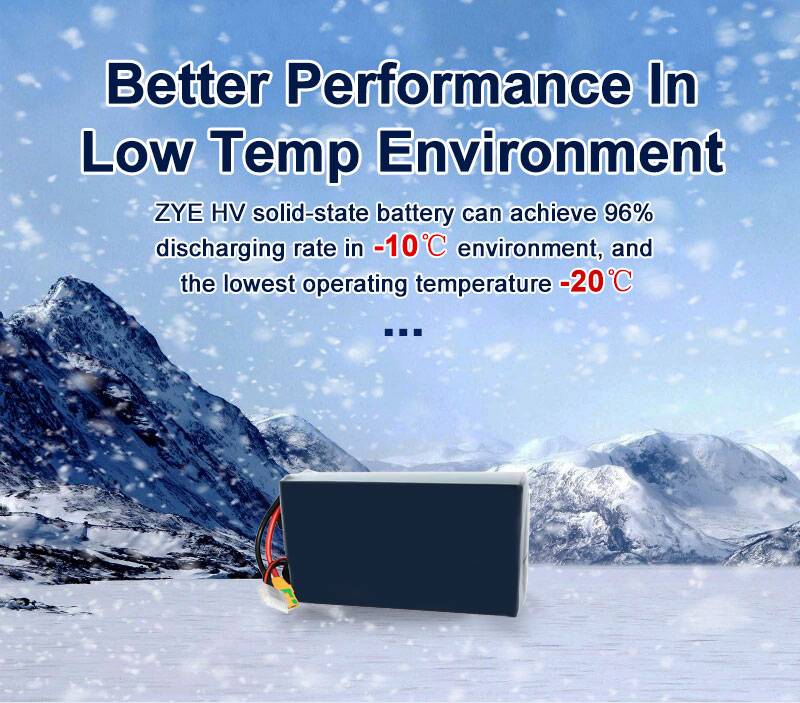
A reasonable expectation for solid state UAV batteries in proper storage conditions — partial charge (40 to 60%), stable temperature between 60 and 75°F, dry environment — is 3 to 5 years of storage life before capacity degradation becomes operationally significant. This compares favorably to LiPo packs, where 2 to 3 years of storage life under careful conditions is more typical.
For seasonal operations or backup battery inventory, that extended storage stability is a meaningful operational advantage beyond what cycle life numbers capture.
What Shortens Lifespan Faster Than Expected
Both clocks run faster under specific conditions that UAV operators control:
High-temperature operation or storage accelerates calendar aging regardless of cycle count. Consistent deep discharge below 20% remaining charge accelerates cycle aging faster than moderate discharge profiles. Frequent fast charging at maximum rated charge rates without temperature management pushes both clocks forward simultaneously.
Solid state batteries tolerate these conditions better than LiPo equivalents — but tolerate isn't the same as immune. The performance advantage narrows when operating conditions are consistently poor.

Planning Battery Replacement for UAV Fleets
For commercial operators building annual battery budgets: cycle frequency determines replacement intervals more accurately than calendar time for high-utilization fleets. For low-utilization fleets and seasonal operations, calendar aging becomes a parallel constraint worth accounting for alongside cycle count.
ZYEBATTERY provides cycle life retention data and storage life guidance for solid state lithium ion and high-performance lithium polymer UAV batteries — because replacement planning works best when both clocks are visible, not just the cycle count on the spec sheet.
Previous:How a solid state battery works?
Send Inquiry



X
We use cookies to offer you a better browsing experience, analyze site traffic and personalize content. By using this site, you agree to our use of cookies.
Privacy Policy
News
 How to build a drone lipo battery pack?2025/08/28