English
 Español
  Português
  русский
  Français
  日本語
日本語  Deutsch
  tiếng Việt
  Italiano
  Nederlands
  ภาษาไทย
  Polski
  한국어
한국어  Svenska
  magyar
  Malay
Malay  বাংলা ভাষার
  Dansk
Dansk  Suomi
Suomi  हिन्दी
  Pilipino
  Türkçe
  Gaeilge
  العربية
  Indonesia
  Norsk
Norsk  تمل
تمل  český
český  ελληνικά
  український
  Javanese
  فارسی
فارسی  தமிழ்
தமிழ்  తెలుగు
  नेपाली
  Burmese
  български
  ລາວ
ລາວ  Latine
  Қазақша
  Euskal
  Azərbaycan
  Slovenský jazyk
  Македонски
  Lietuvos
  Eesti Keel
  Română
  Slovenski
  मराठी
मराठी  Srpski језик

Call Us
+86-15768259626
Email Us
coco@zyepower.com

How a solid state battery works?
How Does a Solid State Battery Work? A Plain Explanation for UAV Operators
Understanding how a solid state battery works doesn't require a chemistry degree. It requires understanding 1 key difference from the batteries you're already familiar with — and then following the logic of what that difference changes.
Here's the clearest explanation of solid state battery operation, written for people who fly drones rather than people who build them.
Start With What Every Battery Does
Every battery — phone battery, drone battery, car battery — does the same basic job. It stores chemical energy and converts it to electrical energy on demand.
Inside every lithium battery are 3 essential components: a positive electrode called the cathode, a negative electrode called the anode, and a middle layer called the electrolyte that sits between them. During charging, lithium ions move from the cathode, through the electrolyte, and into the anode — storing energy in that arrangement. During discharge, those ions move back in the opposite direction, and the energy released in that movement powers the drone's motors.
The electrolyte's job is specific: let lithium ions pass through, but block electrons. Electrons have to travel through the external circuit — through the motor controllers, motors, and flight electronics — which is how they do useful work. If electrons could cross the electrolyte directly, the battery would short-circuit immediately.
What Makes Solid State Different
In conventional lithium polymer batteries, the electrolyte is a liquid or gel — specifically, an organic solvent containing dissolved lithium salts. It works well. It's also flammable, temperature-sensitive, and degrades over time through chemical reactions with electrode surfaces.
A solid state battery replaces that liquid with a solid material. The solid electrolyte still does exactly the same job — letting lithium ions pass while blocking electrons — but it does so through a fundamentally different physical mechanism.
Instead of ions drifting through liquid, they move through a crystalline or amorphous solid structure, hopping between ion-conducting sites within the material. Depending on the electrolyte chemistry, those solid materials might be ceramics (like LLZO — lithium lanthanum zirconium oxide), polymers, or sulfide compounds. Each has different ion conductivity, temperature performance, and manufacturing characteristics.
What Changes About Performance
Because the electrolyte is now solid, several things change simultaneously:
Fire risk drops significantly. The organic solvent that makes liquid electrolytes flammable isn't present. There's nothing to ignite in the thermal runaway sequence that causes lithium battery fires. A mechanically damaged solid state cell loses function rather than becoming a fire hazard.
The cell can accommodate a lithium metal anode. In liquid-electrolyte batteries, lithium metal anodes cause dendrite growth — metallic filaments that eventually short-circuit the cell. Solid electrolytes are dense enough to physically block dendrite penetration, making lithium metal anodes viable. Lithium metal stores roughly 10 times more energy per gram than the graphite anodes used in conventional batteries — which is the source of solid state battery energy density advantages.
Degradation slows down. Liquid electrolytes react gradually with electrode surfaces over hundreds of charge cycles, forming layers that increase internal resistance and reduce capacity. Solid electrolytes are more chemically stable, reacting more slowly with electrode materials. That stability is why solid state batteries demonstrate longer cycle life under comparable operating conditions.
What Hasn't Changed
The fundamental operation — lithium ions moving back and forth between cathode and anode through an electrolyte — is identical to every lithium battery you've used before. The voltage range is similar. The charging and discharging process follows the same principles. The battery still needs a battery management system to monitor cell voltages, manage balancing, and protect against abuse conditions.
Solid state isn't a different type of energy storage. It's the same type, with 1 component — the electrolyte — redesigned in a way that removes the most significant limitations of conventional lithium battery chemistry.

ZYEBATTERY's Solid State UAV Batteries
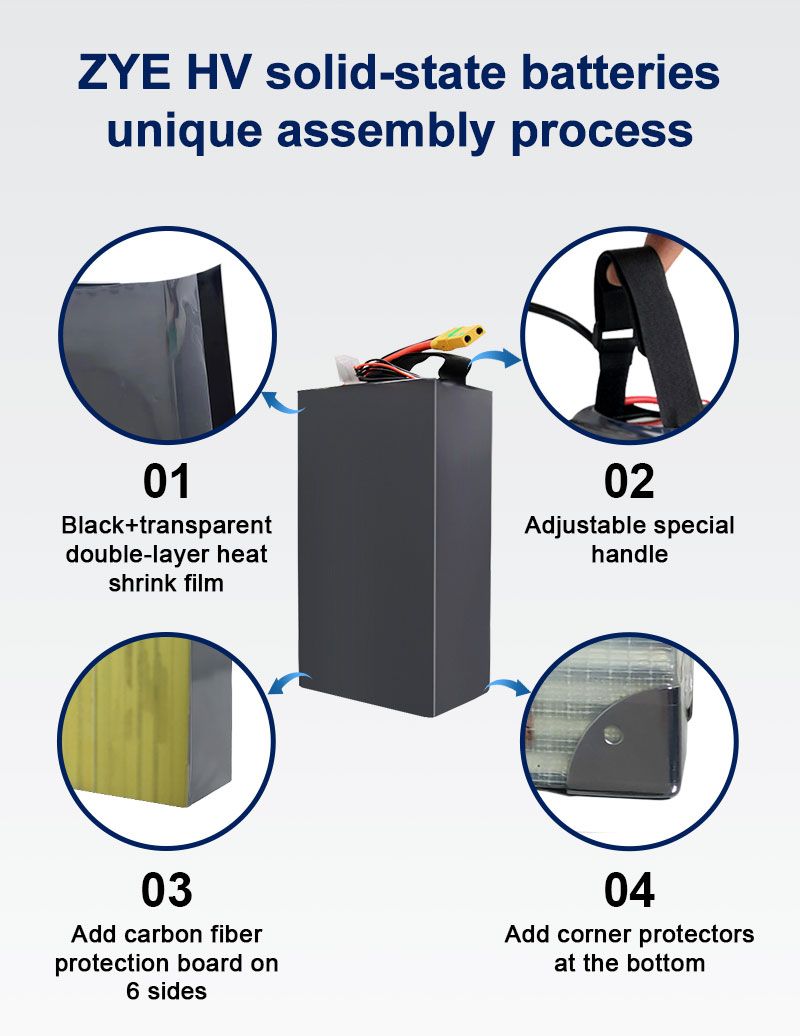
ZYEBATTERY develops solid state lithium ion and high-performance lithium polymer UAV batteries for commercial drone applications. Understanding how the technology works is the starting point for understanding why the performance characteristics differ — and for making battery decisions based on real comprehension rather than spec sheet numbers alone.
Send Inquiry



X
We use cookies to offer you a better browsing experience, analyze site traffic and personalize content. By using this site, you agree to our use of cookies.
Privacy Policy
News
 How to build a drone lipo battery pack?2025/08/28