English
 Español
 Português
 русский
 Français
 日本語
 Deutsch
 tiếng Việt
 Italiano
 Nederlands
 ภาษาไทย
 Polski
 한국어
 Svenska
 magyar
 Malay
 বাংলা ভাষার
 Dansk
 Suomi
 हिन्दी
 Pilipino
 Türkçe
 Gaeilge
 العربية
 Indonesia
 Norsk
 تمل
 český
 ελληνικά
 український
 Javanese
 فارسی
 தமிழ்
 తెలుగు
 नेपाली
 Burmese
 български
 ລາວ
 Latine
 Қазақша
 Euskal
 Azərbaycan
 Slovenský jazyk
 Македонски
 Lietuvos
 Eesti Keel
 Română
 Slovenski
 मराठी
 Srpski језик

Call Us
+86-15768259626
Email Us
coco@zyepower.com

What benefits do solid state batteries offer?
What Benefits Do Solid State Batteries Offer? 6 That Matter Most for UAV Operations
The honest version of this answer isn't a chemistry lecture. It's a list of things that change for UAV operators when they switch from conventional lithium polymer packs to solid state batteries — stated in terms of what actually happens in the field, not what happens at the molecular level.

Here are the 6 benefits that show up most clearly in real commercial UAV operations.
Benefit 1: Flights Run Longer Without Adding Battery Weight
Energy density is the technical term. What it means operationally: more flight time from the same kilogram of battery.
Current solid state UAV batteries are reaching 330 to 400 Wh/kg at the pack level — meaningfully higher than the 200 to 260 Wh/kg typical of quality LiPo packs. For a fixed battery weight budget, that difference translates directly into more minutes in the air per charge. For operators running inspection routes, mapping missions, or delivery operations with defined coverage requirements, longer per-battery flight time means fewer battery swaps, fewer interruptions, and more work completed per crew per day.
Benefit 2: Post-Crash Battery Checks Become Less Stressful
A crashed drone with a damaged LiPo pack carries a fire risk that doesn't resolve immediately. A damaged solid state pack loses function rather than becoming a hazard.
The absence of flammable liquid electrolyte removes the thermal runaway pathway that makes LiPo battery damage management genuinely stressful in the field. Operators can assess damage, recover equipment, and continue working without the added urgency of monitoring a potentially unstable battery. For commercial programs where crashes are occasional rather than never, that difference is felt in real situations.
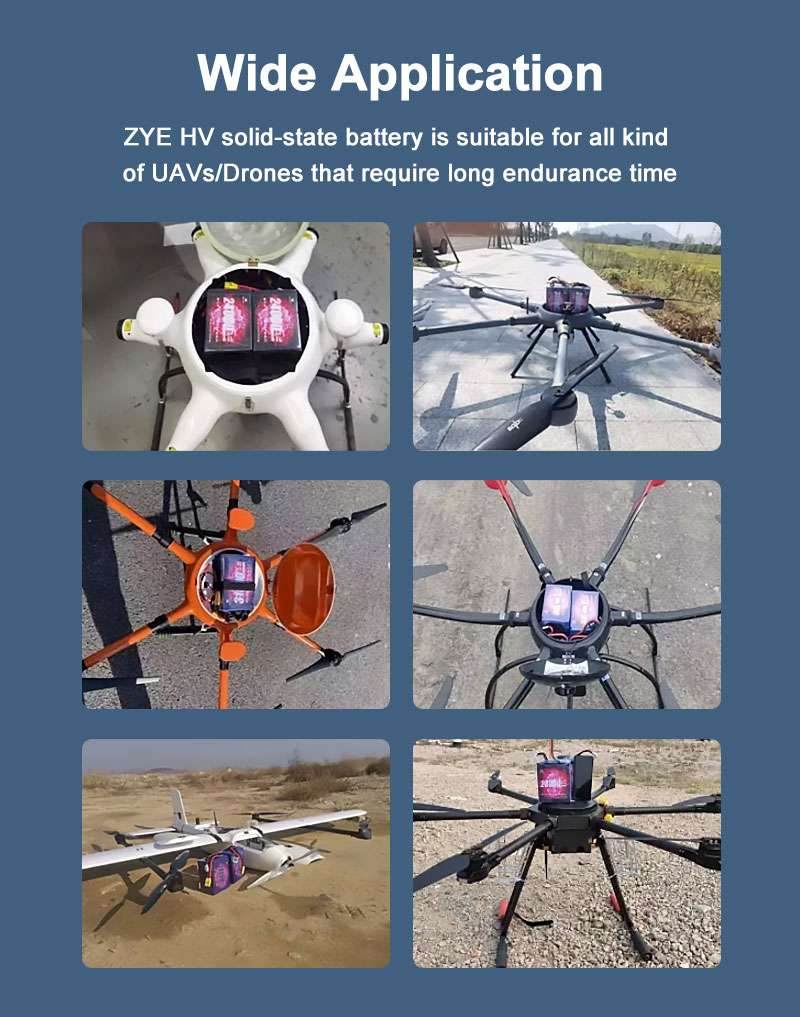
Benefit 3: Batteries Last Longer Before Replacement
More cycles before capacity drops below the operational threshold — 600 to 900 cycles for solid state versus 300 to 500 for equivalent LiPo — means the replacement interval is roughly double.
For a fleet of 10 aircraft running 200 cycles annually each, doubling battery life cuts annual battery procurement roughly in half. That savings compounds across multiple years and multiple aircraft. The higher upfront cost of solid state batteries typically reaches break-even within 12 to 18 months at moderate utilization, then continues generating savings through the extended service life.
Benefit 4: Cold Weather Missions Stay On Schedule
LiPo battery capacity drops noticeably in cold conditions — a pack planned for a 45-minute mission on a 35°F morning might actually deliver 33 to 35 minutes. Solid state batteries maintain more consistent capacity at lower temperatures, narrowing the gap between planned and actual flight windows in cold operating environments.
For operators in northern climates, high-altitude locations, or early-morning winter deployments, that consistency reduces the need for conservative mission planning buffers that cost operational time even when the battery performs adequately.
Benefit 5: Predictable Performance Makes Planning More Reliable
Solid state batteries degrade more linearly than LiPo packs. LiPo degradation often follows a pattern of gradual capacity fade followed by more abrupt decline as cumulative damage reaches a threshold — making the last 20% of a pack's service life less predictable.
Solid state batteries fade more gradually and consistently, which means performance at cycle 600 is more predictable from the data at cycle 300. For commercial operations planning flight times, mission coverage, and maintenance schedules, that predictability has real operational value.
Benefit 6: Regulatory and Insurance Conversations Get Easier
Battery fire risk is a documented factor in how regulators assess UAV operations over populated areas and sensitive sites. The reduced thermal runaway risk of solid state chemistry doesn't automatically unlock new approvals — but it removes a specific objection that has slowed some commercial programs.
Similarly, operators self-insuring or working with insurers who price battery fire risk into premiums find that solid state chemistry changes that conversation in a useful direction.

ZYEBATTERY's Solid State UAV Batteries
ZYEBATTERY develops solid state lithium ion and high-performance lithium polymer UAV batteries for commercial drone operations across all 6 benefit categories above. The right battery for your operation depends on your specific mission profile — and the benefits above are most valuable when the battery is matched to the application rather than selected by spec sheet alone.
Send Inquiry



X
We use cookies to offer you a better browsing experience, analyze site traffic and personalize content. By using this site, you agree to our use of cookies.
Privacy Policy
News
 How to build a drone lipo battery pack?2025/08/28