English
 Español
 Português
 русский
 Français
 日本語
 Deutsch
 tiếng Việt
 Italiano
 Nederlands
 ภาษาไทย
 Polski
 한국어
 Svenska
 magyar
 Malay
 বাংলা ভাষার
 Dansk
 Suomi
 हिन्दी
 Pilipino
 Türkçe
 Gaeilge
 العربية
 Indonesia
 Norsk
 تمل
 český
 ελληνικά
 український
 Javanese
 فارسی
 தமிழ்
 తెలుగు
 नेपाली
 Burmese
 български
 ລາວ
 Latine
 Қазақша
 Euskal
 Azərbaycan
 Slovenský jazyk
 Македонски
 Lietuvos
 Eesti Keel
 Română
 Slovenski
 मराठी
 Srpski језик

Call Us
+86-15768259626
Email Us
coco@zyepower.com

What are the components of a solid state battery?
What Are the Components of a Solid State Battery?
A UAV Operator's Guide to What's Inside
Understanding what a solid state battery is made of isn't just academic curiosity. For UAV operators evaluating competing products or troubleshooting performance issues, knowing which component does what — and how material choices within each component affect performance — helps make sense of spec sheet claims that would otherwise be impossible to evaluate.
Here's a straightforward breakdown of every component in a solid state battery and what it means for the battery in your aircraft.
Component 1: The Cathode (Positive Electrode)
The cathode is where lithium ions originate during discharge and return during charging. It's the positive electrode, and its chemistry determines several key battery characteristics: energy density, voltage output, and thermal stability.
Most commercial solid state UAV batteries use the same cathode chemistries as conventional lithium polymer batteries — NMC (nickel manganese cobalt oxide) or NCA (nickel cobalt aluminum oxide). High-nickel NMC variants like NMC 811 deliver higher energy density at the cost of slightly reduced thermal stability. LFP (lithium iron phosphate) cathodes sacrifice some energy density for better cycle life and cost stability.
The cathode material is the primary driver of the battery's voltage and a significant contributor to its energy density. When solid state batteries claim different energy density figures, cathode chemistry is part of why.
Component 2: The Anode (Negative Electrode)
The anode stores lithium ions during charging and releases them during discharge. Material choice here is 1 of the defining splits within solid state battery technology.
Graphite anodes: Retained from conventional lithium battery designs, graphite is stable and well-understood but has a limited lithium storage capacity of roughly 372 mAh/g. Solid state batteries using graphite anodes deliver improved safety and cycle life over LiPo but similar energy density.
Lithium metal anodes: The design choice behind the highest energy density solid state batteries. Lithium metal stores approximately 10 times more lithium per gram than graphite. The solid electrolyte physically blocks the dendrite growth that makes lithium metal anodes unsafe in liquid-electrolyte batteries — enabling energy densities of 350 to 400+ Wh/kg at the pack level.
Asking whether a solid state battery uses graphite or lithium metal at the anode tells you immediately which energy density category you're evaluating.

Component 3: The Solid Electrolyte
The defining component of solid state batteries — the material that replaces liquid organic electrolyte. It must conduct lithium ions efficiently while blocking electrons, and its properties determine safety characteristics, operating temperature range, and manufacturing complexity.
The 3 main electrolyte families in commercial solid state batteries:
Oxide-based (e.g., LLZO — lithium lanthanum zirconium oxide): Excellent chemical stability, wide electrochemical window, good safety profile. Requires high-temperature sintering during manufacturing, which adds production cost.
Sulfide-based: High ionic conductivity comparable to liquid electrolytes — better performance at room temperature and low temperatures. More reactive with moisture, requiring careful manufacturing and handling conditions. Produces hydrogen sulfide gas if exposed to water — a handling consideration for UAV operators in humid environments.
Polymer-based: Easier to manufacture than ceramics, flexible enough to accommodate volumetric changes during cycling. Lower ionic conductivity than oxide or sulfide types, often requiring elevated operating temperature for optimal performance.
The electrolyte choice shapes everything from charge rate to cold-weather performance to manufacturing cost.
Component 4: Current Collectors
Thin metal foils — typically copper at the anode and aluminum at the cathode — that conduct electrons from electrode materials to the external circuit. Less glamorous than other components but critical for efficiency. Poor current collector contact increases internal resistance and reduces effective power delivery.
Component 5: The Battery Management System (BMS)
Not technically inside the cell itself, but inseparable from a functional UAV battery. The BMS monitors individual cell voltages, manages balancing between cells, controls charge and discharge limits, tracks temperature, and communicates telemetry to the flight controller.
For solid state UAV batteries, BMS calibration matters specifically: protection thresholds need to reflect the actual operating characteristics of solid electrolyte cells, which behave differently from liquid-electrolyte cells under load — particularly at temperature extremes.
Component 6: Pack Housing and Thermal Management
The physical enclosure that holds cells, BMS, connectors, and wiring. For UAV batteries, housing design affects weight, vibration resistance, connector placement, and heat dissipation. Solid state cells are less sensitive to thermal runaway but still benefit from housing designs that manage operating temperature for optimal cycle life.
ZYEBATTERY's Component Transparency
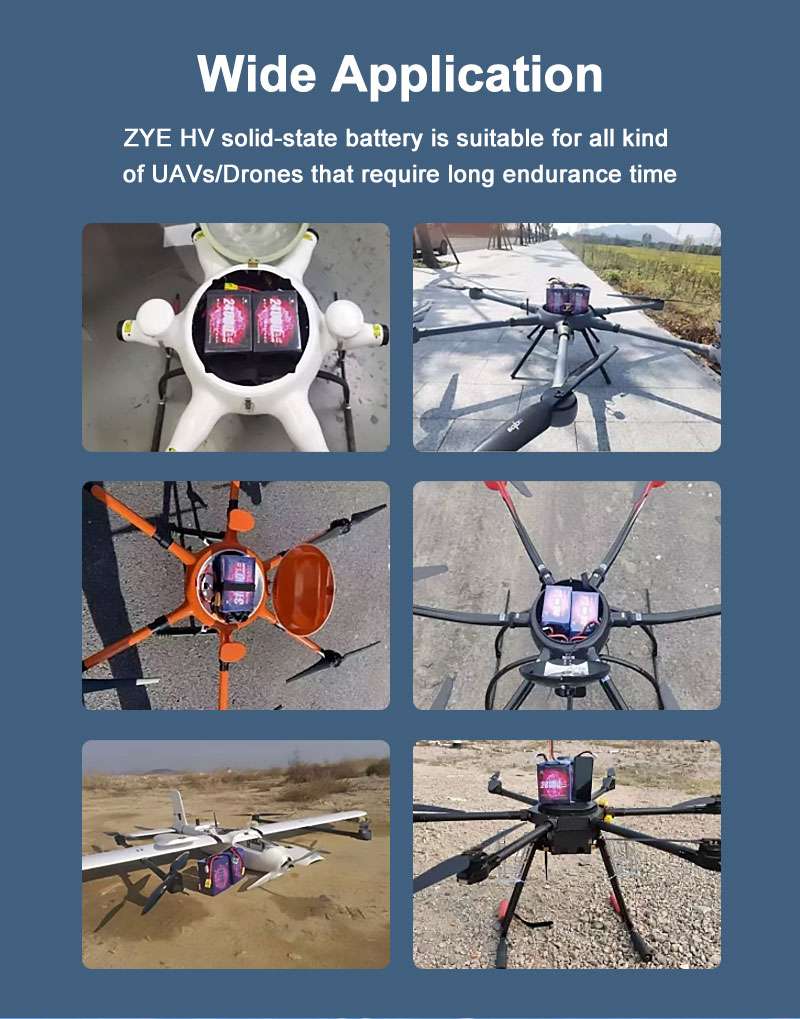
ZYEBATTERY provides component-level specifications for solid state lithium ion and high-performance lithium polymer UAV batteries — including electrolyte chemistry, anode architecture, cathode material, and BMS calibration approach. For UAV operators making performance-based procurement decisions, those details aren't optional extras. They're the information that makes spec sheet comparison meaningful.
Send Inquiry



X
We use cookies to offer you a better browsing experience, analyze site traffic and personalize content. By using this site, you agree to our use of cookies.
Privacy Policy
News
 How to build a drone lipo battery pack?2025/08/28