English
 Español
  Português
  русский
  Français
  日本語
日本語  Deutsch
  tiếng Việt
  Italiano
  Nederlands
  ภาษาไทย
  Polski
  한국어
한국어  Svenska
  magyar
  Malay
Malay  বাংলা ভাষার
  Dansk
Dansk  Suomi
Suomi  हिन्दी
  Pilipino
  Türkçe
  Gaeilge
  العربية
  Indonesia
  Norsk
Norsk  تمل
تمل  český
český  ελληνικά
  український
  Javanese
  فارسی
فارسی  தமிழ்
தமிழ்  తెలుగు
  नेपाली
  Burmese
  български
  ລາວ
ລາວ  Latine
  Қазақша
  Euskal
  Azərbaycan
  Slovenský jazyk
  Македонски
  Lietuvos
  Eesti Keel
  Română
  Slovenski
  मराठी
मराठी  Srpski језик

Call Us
+86-15768259626
Email Us
coco@zyepower.com

What’s the Top High Voltage Battery for UAV Long-Range Mission Success?
Let’s paint a picture. Your fixed-wing UAV is on a crucial pipeline inspection. The planned route is tight, but doable. Then you hit stronger-than-expected headwinds. You watch the battery percentage drop faster than your stomach. That “Return-to-Home” trigger feels like a mission failure. Sound familiar?
If you’ve been here, you know the problem isn’t just capacity. It’s efficiency. And that’s where the entire conversation about UAV long-range mission success shifts to one critical component: the high voltage battery.
So, what actually makes a top-tier high voltage battery for these demanding flights? It’s not about a single magic cell. It’s about a system designed from the ground up to squeeze every possible watt-minute of usable energy into your airframe. Let’s break down what you should really be looking for.
Why Voltage Matters: It’s Physics, Not Hype
First, a quick layman’s terms refresher. Think of your drone’s powertrain like a water pipe system. Power (watts) is the total water flow. You can get that flow with a high volume of water at low pressure (high current, low voltage), or less water at much higher pressure (lower current, high voltage).
A top high voltage battery (typically operating at 22.8V, 25.2V, or higher for UAVs) uses that “higher pressure” model. The immediate benefit? It reduces energy loss as heat in the wires, ESCs, and motors. Less wasted energy directly translates to more energy for thrust. This means longer flight times from the same physical battery weight or the ability to use a lighter, smaller pack for the same duration. For long-range success, this efficiency gain isn’t just nice-to-have; it’s the fundamental edge.
Beyond the Label: Key Marks of a True Performer
Anyone can series-connect more cells to get a higher voltage. The real art lies in the engineering that ensures performance, safety, and longevity. Here’s your checklist:
Cell Quality & Matching: This is the foundation. Premium, low-internal-resistance cells are non-negotiable. More importantly, they must be meticulously matched for capacity and impedance within the pack. In a high voltage configuration, a single weak cell doesn’t just ruin your day; it can compromise safety and kill the entire pack’s lifespan. Top manufacturers obsess over this matching process.
The Intelligence Layer: A Smart, Robust BMS: The Battery Management System is the brain. For a high voltage drone battery, it needs to be sophisticated. We’re talking about precision cell balancing under high loads, accurate state-of-charge calculation (so you actually trust that remaining percentage!), and a suite of protections (over-voltage, under-voltage, temperature) that are tuned for real-world aviation stress. A basic BMS is a liability.
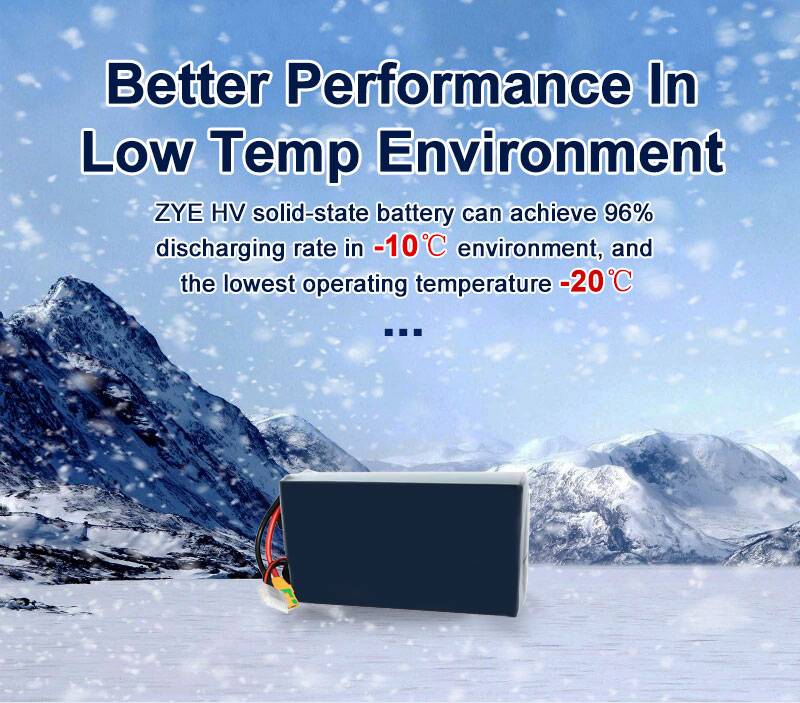
Built for the Environment: Your mission doesn’t happen in a lab. A top battery is encased and engineered to handle it. Think conformal coatings on the PCB to combat humidity, vibration-resistant soldering and connections, and thermistors placed to give a true reading of core temperature. Whether it’s a hot desert survey or a high-altitude mapping job, the pack must perform reliably.
The Game-Changer: High Voltage Meets Fast Charging
Here’s an often-overlooked advantage. A well-designed high voltage system is a friend to fast charging. With the right supporting charger, these packs can often accept a higher charge current safely, slashing ground time between sorties. For commercial operators, this isn’t just about one long flight; it’s about total missions per day. Long-range success also means high-uptime success. The ability to reliably fast-charge without degrading the pack is a massive operational advantage.
Looking Ahead: Where Solid-State Fits In
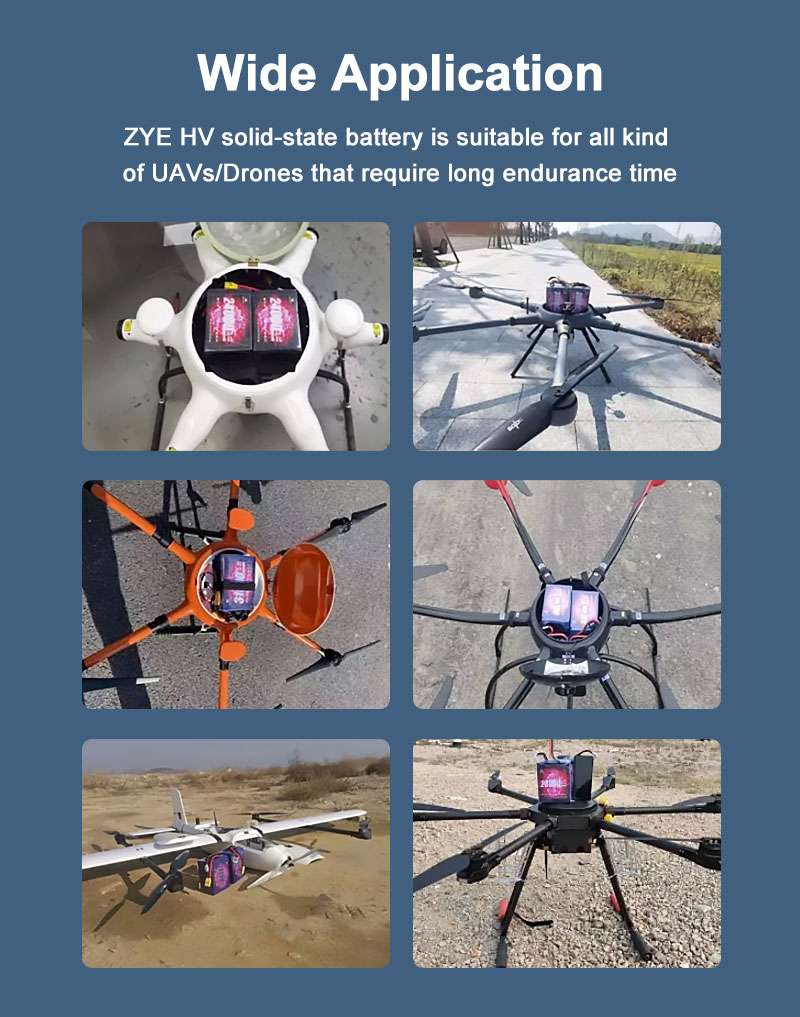
The future of endurance points toward solid-state lithium-ion technology. While still evolving for mass-market UAVs, its potential for higher energy density and superior safety aligns perfectly with the demands of long-range, high-voltage applications. Forward-looking manufacturers are already prototyping and integrating these next-gen cells into their design philosophy, aiming to offer the next leap in performance.
So, What’s the Top Choice?
The “top” high voltage battery for UAVs isn’t a single brand name you pick off a shelf. It’s the solution that checks all these engineering boxes and is tailored to your specific application’s voltage, capacity, discharge profile, and physical constraints.
At ZYEBATTERY, we build our high-voltage LiPo packs with this systems-thinking approach. We start with Grade-A cells, govern them with our proprietary smart BMS, and house them in packs built to endure. Our goal is to be the power behind your most ambitious missions, turning range anxiety into mission confidence.
Ready to push your operational limits? The best way to find your top high voltage battery is to start a technical conversation. Tell us about your drone, your mission profile, and your endurance goals. We’ll help you engineer the efficient, reliable power solution that makes long-range success your standard outcome.
Contact us today to discuss your requirements or to request a performance evaluation sample. Let's power your vision, further.
Send Inquiry



X
We use cookies to offer you a better browsing experience, analyze site traffic and personalize content. By using this site, you agree to our use of cookies.
Privacy Policy
News
 How to build a drone lipo battery pack?2025/08/28