English
 Español
  Português
  русский
  Français
  日本語
日本語  Deutsch
  tiếng Việt
  Italiano
  Nederlands
  ภาษาไทย
  Polski
  한국어
한국어  Svenska
  magyar
  Malay
Malay  বাংলা ভাষার
  Dansk
Dansk  Suomi
Suomi  हिन्दी
  Pilipino
  Türkçe
  Gaeilge
  العربية
  Indonesia
  Norsk
Norsk  تمل
تمل  český
český  ελληνικά
  український
  Javanese
  فارسی
فارسی  தமிழ்
தமிழ்  తెలుగు
  नेपाली
  Burmese
  български
  ລາວ
ລາວ  Latine
  Қазақша
  Euskal
  Azərbaycan
  Slovenský jazyk
  Македонски
  Lietuvos
  Eesti Keel
  Română
  Slovenski
  मराठी
मराठी  Srpski језик

Call Us
+86-15768259626
Email Us
coco@zyepower.com

Does a 6S Lipo Battery Outperform Solid State in FPV Racing?
If you’re an FPV racer—whether you’re chasing podiums or just racing for the thrill—you know one thing: your battery is your secret weapon. Every millisecond, every burst of speed, and every sharp turn depends on the power your battery delivers. The big debate in the FPV community right now? Does a 6S Lipo battery outperform a solid state battery in FPV racing? Today, I’m breaking this down like we’re hanging in the pits after a race—no tech jargon, just real talk from someone who’s been there, straight from ZYEBATTERY, your go-to for high-performance FPV and drone batteries.
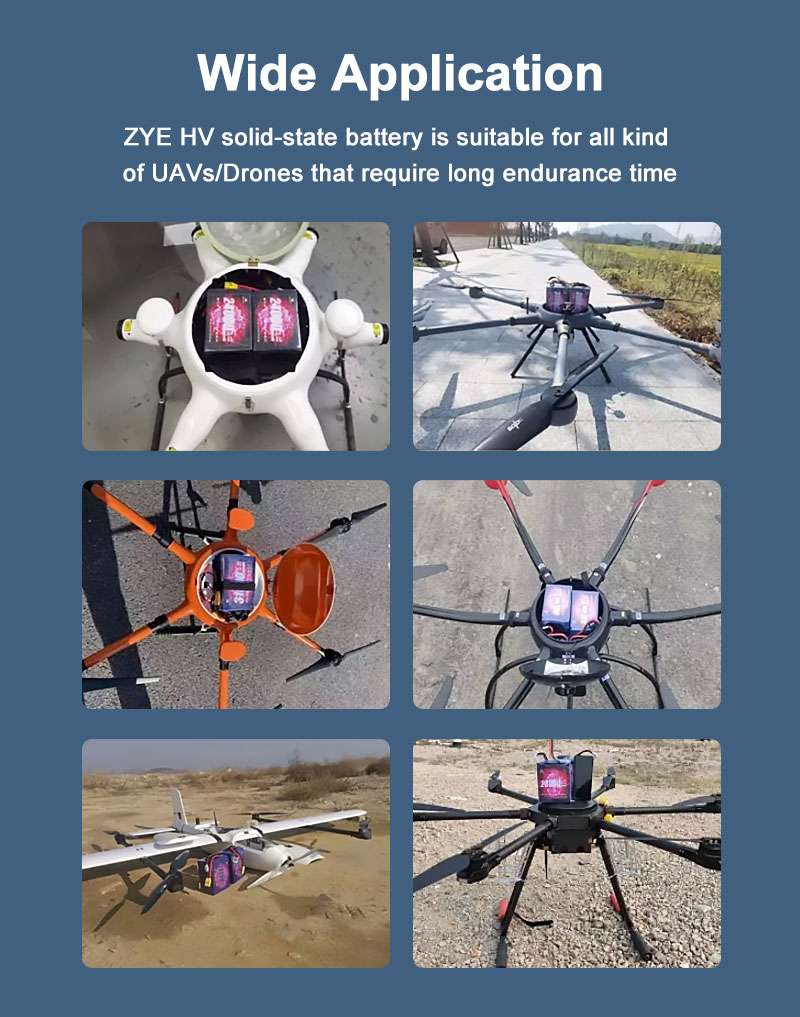
Let’s start with the basics: 6S Lipo batteries have been the FPV racing standard for years, and for good reason. FPV racers need instant power—quick acceleration to hit top speeds, consistent thrust to pull out of tight turns, and a discharge rate that keeps up with the most demanding motors. 6S Lipo batteries deliver that, plain and simple. They’re lightweight, affordable, and designed to dump power fast—exactly what you need when you’re flying at 80+ mph and fighting for position. Most pro racers still swear by 6S Lipo batteries because they know what to expect: reliable, instant power every time.
Now, solid state batteries are the new kid on the block, and they’re turning heads. They’re lighter than 6S Lipo batteries, have a longer cycle life, and are way safer—no risk of swelling or catching fire if you crash (and let’s be real, FPV racers crash a lot). But here’s the catch: when it comes to raw performance—the kind that wins races—do they stack up to 6S Lipo? For most FPV racers, the answer right now is no, but it’s close.
The biggest difference is discharge rate. 6S Lipo batteries have higher continuous discharge rates, which means they can deliver more power faster. In FPV racing, that translates to quicker acceleration and more responsive throttle control—two things that can make or break a race. Solid state batteries are catching up, but they still can’t match the instant power dump of a high-quality 6S Lipo battery. At ZYEBATTERY, our 6S Lipo batteries are engineered for FPV racing specifically, with discharge rates up to 150C, so you get that instant power when you need it most.

But let’s not sleep on solid state batteries. They have their own advantages that matter for racers. They’re more durable—so if you crash hard, you’re less likely to damage your battery. They also hold their charge longer, so you can get more practice flights in between charges. And while they don’t quite match 6S Lipo in raw speed, they’re more consistent over time—no voltage sag mid-race, which means you can maintain speed longer without losing power.
So, does a 6S Lipo battery outperform solid state in FPV racing? Right now, yes—if raw speed and instant power are your top priorities. But solid state is closing the gap fast. At ZYEBATTERY, we offer both: high-performance 6S Lipo batteries for racers who want to win, and cutting-edge solid state batteries for those who value durability and consistency. We engineer both to meet the demands of FPV racing, so you can choose the battery that fits your style.
At the end of the day, the best battery for FPV racing is the one that fits your needs. 6S Lipo is still king for raw performance, but solid state is a game-changer for durability and consistency. No matter which you choose, ZYEBATTERY has you covered—because we know FPV racing isn’t just a hobby; it’s a passion, and your battery should keep up. Don’t settle for a battery that holds you back—choose one that helps you fly faster, crash harder, and race better.
Send Inquiry



X
We use cookies to offer you a better browsing experience, analyze site traffic and personalize content. By using this site, you agree to our use of cookies.
Privacy Policy
News
 How to build a drone lipo battery pack?2025/08/28